ABM & Intent Data Were the First Generation. Signals and GTM Intelligence is the Future.
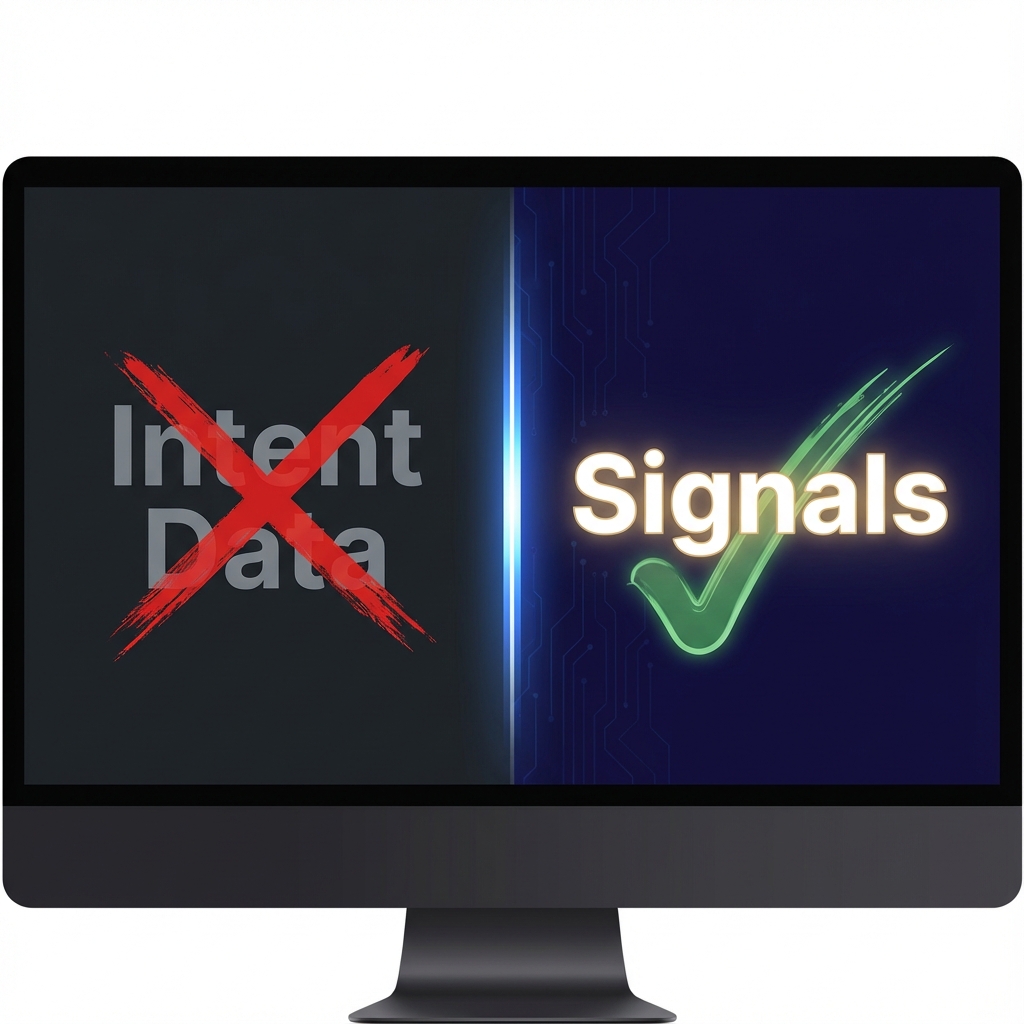
For more than a decade, Account-Based Marketing (ABM) ran on one fundamental input: intent data.
When companies like Bombora, G2, and later 6sense turned intent into a category, it reshaped how marketing prioritized accounts. It was seen as the missing intelligence layer — the promise that “if an account is researching your problem, you’ll know.”
It was groundbreaking for its time.
But the world it was built for no longer exists.
Buying behavior has changed. Committees have expanded. Digital noise has exploded. Stakeholders move faster than intent data can refresh.
And today, the truth is simple: Intent data and first-generation ABM cannot keep up with how enterprise deals actually move.
Where ABM + Intent Fall Short (And Why They’re Mostly Noise Now)
Classic ABM models rely heavily on broad signals: keyword surges, category consumption, comparison pages, IP lookups, and inferred interest.
But here’s the problem:
Intent does not tell you a company is interested. It tells you someone, somewhere in that company triggered an anonymous activity spike.
That could be:
- An intern researching a college project
- A competitor checking your pricing
- A vendor browsing your content
- A random employee Googling an article that loosely matches your space
Intent is not conviction. It’s not buying behavior. It’s not deal movement.
Most of the time, it’s noise disguised as insight.
And this is why intent + ABM fall apart in real enterprise cycles:
- It’s account-level, not human-level — you don’t know who actually cares.
- It has no context — spikes mean nothing without the “why.”
- It arrives late — weekly surges don’t support real-time selling.
- It ignores internal dynamics — reorgs, politics, influence shifts.
- It doesn’t enable personalization — too broad for persona-level relevance.
- It gives no actionable next step — reps still guess what to do.
Signals: The Real Indicators of Deal Movement
Signals are the micro-movements, human behaviors, organizational changes, and contextual shifts inside an account that actually influence a deal.
They’re real. They’re specific. They’re time-sensitive. They’re actionable.
Here are stronger, more complete examples:
Stakeholder Signals
- A VP shares an article about a problem your product solves
- A compliance head comments on a regulatory update
- A champion suddenly stops engaging (engagement decay)
- A new director joins with a background in a competing solution
- A CTO publicly discusses a shift to cloud-first strategy
- A security architect likes content about breach prevention
- A procurement officer follows your company page
Organizational Signals
- A hiring spike in a function tied to your value proposition
- A major customer win announced by the target account
- A restructuring that changes decision authority lines
- A board member joining with experience in your category
- A press release signaling a transformation mandate
- A new CFO known for cost optimization initiatives
Deal Signals
- New stakeholders viewing the proposal
- Proposal forwarded internally
- Lag in replies after weeks of momentum
- Meeting invites including additional evaluators
- Increased activity on your website from a specific department
- Higher-than-usual time spent on security documentation
These signals matter because they reflect reality inside the deal — not anonymous external noise. Signals show who is leaning in, who is backing out, who is gaining influence, and when the political window is open.
Intent data cannot do that. ABM campaigns do not react to that. But modern GTM teams must.
Where Honeycomb Fits In — And Why It’s Built for the Post-Intent Era
Honeycomb is designed for a world where precision matters more than volume, and timing matters more than scoring.
Honeycomb doesn’t just surface signals — it understands them, contextualizes them, and turns them into exact next steps for every stakeholder in every account.
Here’s how:
1. Automatic Buying Committee Mapping
Honeycomb identifies decision-makers, influencers, cross-functional players, and hidden blockers.
2. Deep Persona Intelligence
Tone, preferences, DISC profile, channel habits, and role weight — all mapped automatically.
3. Real-Time Signal Detection
Honeycomb tracks micro-signals across individuals, teams, and the entire company — the moments that actually drive deal movement.
4. Action Generation (The Missing Layer in ABM)
For each stakeholder, Honeycomb recommends the next best action: Who to engage, what to say, when to act, where to act, and how to multi-thread.
5. Continuous Learning Loop
Every action leads to an outcome, and every outcome makes the system smarter.
It’s not a dashboard. It’s not a report. It’s not “better intent.”
Honeycomb is an orchestration engine driven by real-time signals — the layer ABM never had and intent could never provide.
The First Generation Found Accounts. The Next Generation Moves Deals.
ABM helped identify accounts. Intent helped prioritize them.
But neither could explain the human dynamics behind a deal — or guide a seller through them.
Signals finally bridge that gap.
They show what is happening, why it’s happening, and how a seller should respond.
This is the next evolution of GTM. And Honeycomb is building the platform designed for it.
If the last decade belonged to ABM and intent data, the next decade belongs to signals — and to the teams who learn to use them first.